

When the clocks fall back on Sunday, November 1, Northern Virginia loses an hour of evening daylight overnight. By December it’s dark before 5 p.m., and most of us leave and come home in the dark. Suddenly the porch light that was fine all summer looks dim, the front walk disappears, and the garden you worked on all year vanishes the moment the sun goes down.
That makes late fall the ideal time to plan outdoor lighting. The leaves are down, so you can see the branch structure of your trees. You notice the dark spots on your property every evening. And there’s still time to install before the ground freezes.
Here’s how to approach outdoor lighting for a Northern Virginia home, from the front door to the back fence.
Start with the zones you use every night
Walk your property after dark and note where you actually go, including side gates, the trash-can route, and the back door. Most homes have five zones:
- Entry. The front door is the first impression and the most important safety point. Lanterns on either side of the door should light faces as well as the lock. A flanking pair usually looks right at roughly a quarter to a third of the door’s height.
- Paths and steps. Low path lights or step lights should mark the route from the driveway to the door without turning it into a runway.
- Driveway and garage. Fixtures beside or above the garage doors help with parking and security.
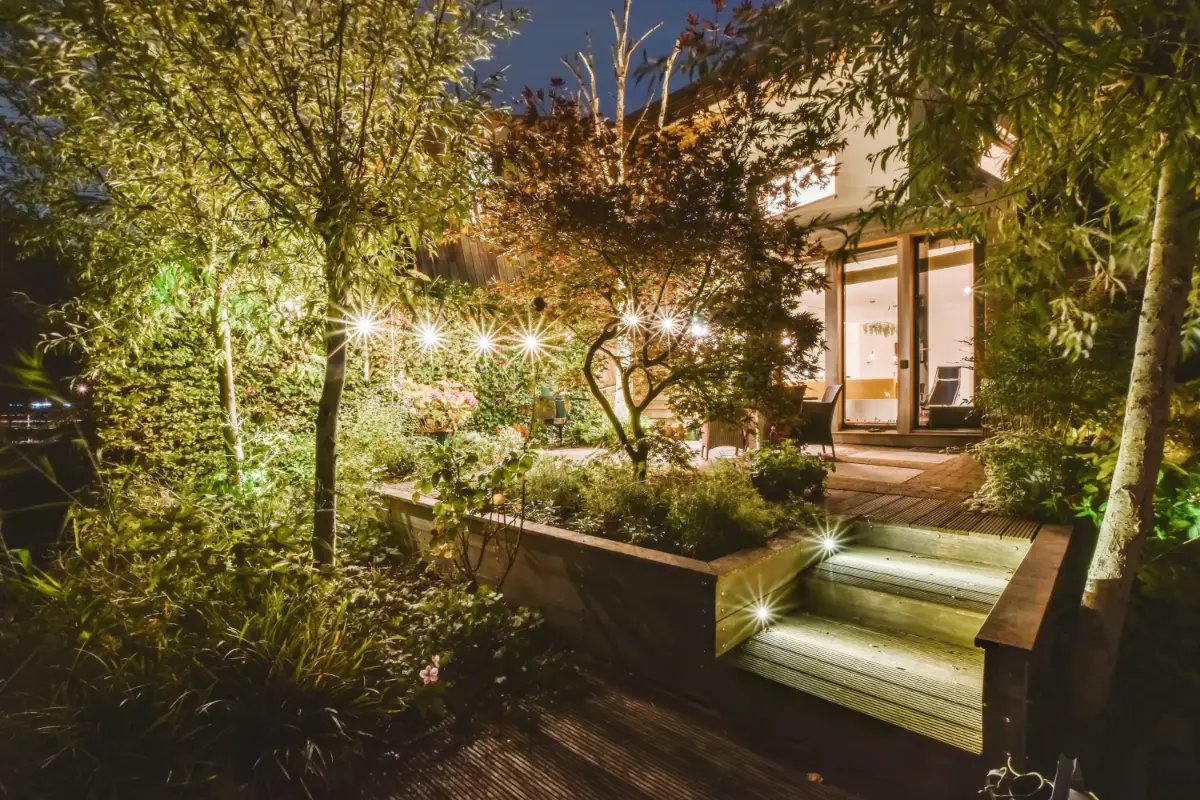
- Facade and landscape. Gentle uplighting on the house and key trees gives the home depth and makes it look lived-in.
- Patio and deck. Outdoor living areas need softer, dimmable light for evenings outside.
Covered porches often use recessed downlights in the ceiling. The planning principles in our homeowner’s guide to recessed lighting in Northern Virginia apply here too, but the fixtures must be rated for damp locations.
Know the local rules before you buy
Northern Virginia jurisdictions take light pollution seriously. Under Fairfax County’s outdoor lighting standards, new and replacement residential fixtures should be full cut-off, meaning no light is emitted above the bottom of the fixture, and mounted level with the ground. Bulbs should be rated 3000K or lower.
There are practical exemptions for single-family homes and townhouses. Fixtures of 1,500 lumens or less don’t need to meet the full cut-off and shielding rules. Motion-activated lights of up to 4,000 lumens are exempt if they switch off within five minutes and stay aimed within your property. Spotlights on trees, flags, or architecture must be aimed and shielded so the light stays on the object, and holiday lighting is exempt. Stricter limits apply near the Turner Farm Park observatory in Great Falls.
Arlington, Loudoun, and other localities set their own rules, so check with your county before installing anything bright or tall.
Choose warm light and control glare
The 3000K limit is good design advice anywhere. Warm white light between 2700K and 3000K flatters brick, stone, and foliage, and feels welcoming rather than clinical.
Glare is the most common outdoor lighting mistake. A bare, bright bulb by the front door makes it harder, not easier, to see the steps beyond it. Look for fixtures with frosted or seeded glass, shielded lamps, and modest output. Several well-placed, softer lights beat one floodlight every time.
Pick fixtures built for the weather
Our climate brings humid summers, freezing nights, and the occasional ice storm, so ratings matter:
- Wet-location fixtures are for anything exposed to rain: lanterns on an uncovered wall, path lights, and in-ground uplights.
- Damp-location fixtures are for covered porches and areas sheltered from direct rain.
- Solid brass, copper, and marine-grade finishes hold up better than painted steel, and brass develops a natural patina over time.
For landscape lighting, low-voltage systems are the norm. They run from a transformer, are safer around soil and water, and are easy to adjust as plants grow.
Let the lights run themselves
The best outdoor lighting doesn’t depend on anyone remembering a switch. An astronomical timer calculates sunset for your location every day, so lights come on at dusk in December and later in June without resetting. Add motion sensors for the driveway and side yard, and a late-evening setting that dims landscape lights at a set hour.
Plan the inside of the front door at the same time. Light that carries from the porch into the foyer and hallway makes a home feel welcoming from the first step. For ideas, browse our guide to modern hallway light fixtures.
When to bring in a designer
Swapping a front-door lantern is a weekend project. A full landscape plan, with uplighting on mature trees, path lighting along a long walk, and zones on separate transformers, benefits from a professional. Before you start, learn what a landscape lighting designer does and how the process works.
If outdoor lighting is part of a larger project, budget for it alongside the interior work. Our breakdown of what determines lighting renovation cost covers fixtures, labor, and controls.
See outdoor fixtures in person
Outdoor fixtures look very different in a catalog than on a wall, and lantern size is easy to misjudge from a photo. Visit our Chantilly or Arlington Design Center to compare finishes and scale, and book a complimentary lighting consultation to plan your outdoor lighting before winter sets in.




 English
 Spanish